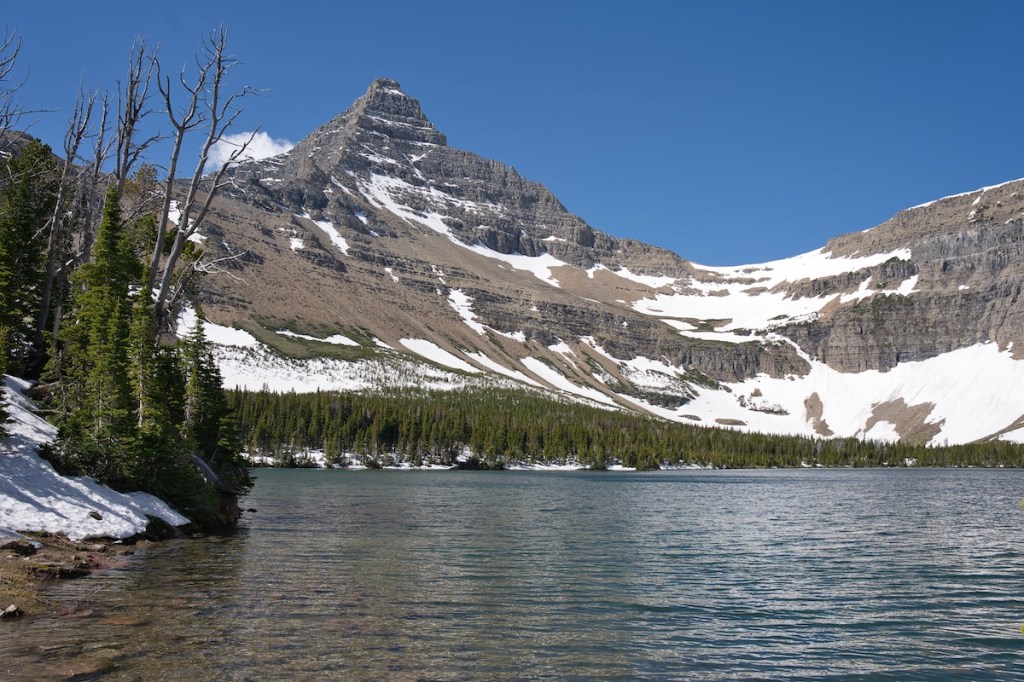
This hike is worthy of your consideration in June when Dawson and Pitamakan Passes are still snowed in. If you are taking on the Dawson Pitamakan Loop later in the summer, it only adds 0.8 miles to include the lake as a quick side trip.
Trailhead
This hike is on the east side of Glacier National Park in the Two Medicine Region. From East Glacier, Montana, drive north 4 miles on Highway 49. Look for the turn on your left. The campground near the trailhead is eight miles farther after the turn.
Turn right at the Two Medicine Ranger StatIon and drive 0.6 miles through the campground toward the north end of Pray Lake. There, you will find a small parking area on the left side of the road. Head west from the parking lot and follow the path towards the bridge that crosses Two Medicine Creek at the outlet of Pray Lake. Continue on the footpath until you come to a T-intersection. Turn right onto the Pitamakan Trail.
Grizzly bears use this area. During my last trip, there were two grizzlies about 2.5 miles from the trailhead. At times, the wind blowing through the trees can be very noisy in this country, which can make it difficult for a bear to know you’re in the area and move away. Try your best to be loud enough, especially coming to a blind curve in the trail or traveling through thick brush. A surprised bear is not a good thing. As always, carry bear spray and know when and how to deploy it.
Hike Summary
| Total Distance: 12.8 miles |
| Total Elevation Gain: 1,858 feet; Loss: 342 feet |
| Difficulty: 16.5, strenuous (Calculated using Petzoldt’s Energy Rated Mile equation.) |
| Total Walking Time: 6 hours (Calculated using an average moving speed of 2.5 mph and Naismith’s correction for elevation gain.) |
The Hike
During the first 1.4 miles, you’ll climb 384 feet to the top of the ridge extending east from Rising Wolf Mountain. As the path descends, the forest transitions from subalpine fir and spruce with lots of bear grass and thimbleberries to more open lodgepole pine and subalpine fir stands with small meadows.
At the start of the season, you’ll cross several creeks, with only two providing a footbridge. The first hiker’s bridge is over Dry Fork. After crossing the bridge and then a short walk, the Dry Fork Trail comes in from the right to join the Pitamakan Trail. Turn left for Oldman Lake, which is a little over four miles away from the trail intersection.
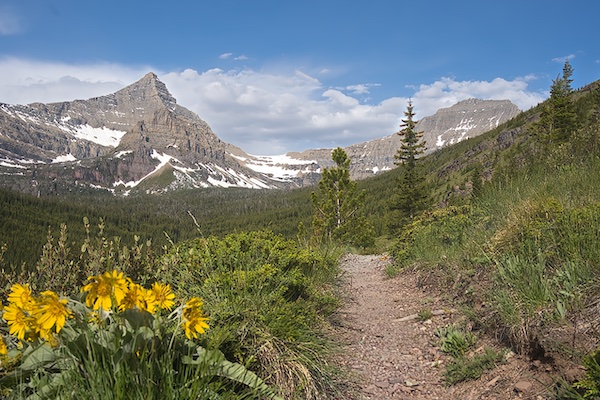
For the next couple of miles, the footpath meanders through the trees with occasional views of the north cliffs of Rising Wolf Mountain. Around 3.5 miles from the trailhead, huckleberry bushes are abundant. At four miles, the forest opens up, revealing spectacular views.
Along the way, you’ll notice the pale, ashen trunks of lifeless whitebark pines. White pine blister rust, an imported fungal disease, likely killed them. After over-harvesting extensive forests of eastern white pine, it occurred to folks that they should begin replanting the denuded areas. The problem was that American nurseries did not have the production potential needed. So, the United States shipped white pine seeds to Germany to raise and then ship back. This was cheaper than doing it in the United States for whatever reason.1
The presence of white pine blister rust in Germany was confirmed by 1865, and by 1900, it had spread across northern Europe. In 1898, Dr. Carl A. Schenck, a German forester, warned the U.S. about importing seedlings from Germany and predicted disaster for America’s white pines should they do so. The warnings went unheeded. By 1909, millions of seedlings were being imported. People detected the disease on the east coast in 1909, the west coast 1921, northwest Montana 1927 and Glacier National Park in 1939.1,2
For years, specialists in Glacier National Park have been identifying individual trees that appear to be immune to the rust. Park revegetation crews collect cones from these trees. A Forest Service nursery in Idaho raises the seedlings and then the revegetation crews plant them back into the same areas where they collected the cones. I hope it works.
Whitebark pine seeds have served as a significant food source for many species. The hardy-drought-tolerant trees inhabit harsh high elevation sites and stabilize soil, slow snowmelt, colonize disturbed areas, and provide micro-environments that help other plant species become established. Ecologists labeled it a keystone species because it plays such a crucial role in its ecosystem.
Look for the trail junction for Oldman Lake at 6.0 miles. (Pitamakan Pass is 1.5 miles with 881 feet of elevation gain from this junction.) The footpath leads to the backcountry campground, which has four sites. Three are reservable. Expect the campground to open mid-July.

A short walk from the campsites brings you to the beautiful 40-acre Oldman Lake nestled in its cirque beneath Pitamakan Pass to the north, Mount Morgan to the west and the glacial horn Flinsch Peak to the southwest. At 6,646 feet above sea level, Oldman matches the elevation of Logan Pass on the Going-to-the-Sun Road.
Oldman Lake delivers a perfect blend of beauty and serenity that captures the magic of Glacier National Park. Standing by the lake’s edge, surrounded by mountains sculpted by glaciers, I find the peacefulness of this secluded spot restorative.
Notes
- Benedict, Warren V. History of White Pine Blister Rust Control—A Personal Account. Washington D.C.: USDA Forest Service, 1981.
- “White Pine Blister Rust.” High Elevation White Pines. https://www.fs.usda.gov/rm/highelevationwhitepines/Threats/blister-rust-threat.htm.
 EXPERIENCE GLACIER NATIONAL PARK