Trailhead
From the North Fork entrance station, turn right onto the Inside North Fork Road. Drive three miles and look for the Lone Pine Prairie sign on the right. Just before the sign, you will find a small parking area. The trailhead is across the road to the left.
Hike Summary
| Total Distance: 3.0 miles |
| Total Elevation Gain: 253 feet; Loss: 11 feet |
| Difficulty: 3.5, easy (Calculated using Petzoldt’s Energy Rated Mile equation.) |
| Total Walking Time: 1 hour 20 minutes (Calculated using an average moving speed of 2.5 mph and Naismith’s correction for elevation gain.) |
The Hike
This out and back hike is short and sweet just like this post.
The footpath leads you through a lodgepole pine forest that replaced the trees incinerated by the 1988 Red Bench Fire. Tall western larch snags are a hint of the previous forest. The surviving larch still have their scorched bark, but thankfully, they are a source of seed to perpetuate this magnificent species.
Along the way to the meadow, yellow heart-leaved arnica, pink pussytoes, early blue violet, white strawberry blossoms, purple lupine and others provide showy evidence of the resilience of this ecosystem.
You’ll know Hidden Meadow is close when the trail enters a moist area with large spruce trees, which then give way to small stands of aspen.
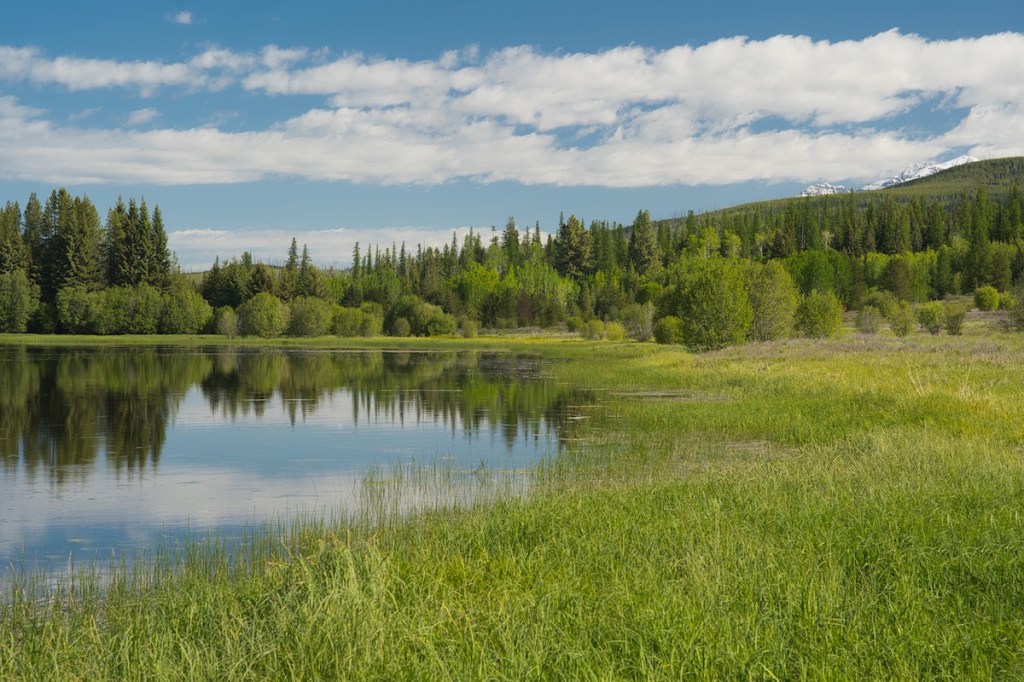
Once you enter the meadow, you’ll notice the large pond off to the left – a beautiful accent to the scene. The last time I entered the meadow, the wail and tremolo of loons greeted me, while a couple of white-tailed deer grazed in belly-deep grass near the south end of the still water. You can see a couple of summits from the Livingston Range peeking over a ridge to the east.

The treeline to the east is the approximate boundary of the 160-acre homestead, a 32-year-old Ben Maes established in 1909—a year before Congress created Glacier National Park. Maes, a large powerful man, emigrated from Holland and gained a reputation for his log craftsmanship. Many North Fork homesteaders benefited from his skills. Maes also ran some cattle and raised root vegetables.1
He sold his land in 1947 to John W. Slifer, who likely built the large earthen dam that created the pond. After changing hands one more time, the U.S. government bought the homestead in 1968.1
As I sauntered through the meadow, I tried to imagine the hard work and perseverance that was required to live in this remote landscape in the early 1900s. This hike offers stories and experiences you get to own — from the rebirth of the forest after the Red Bench Fire, the legacy of Ben Maes, and the eerie wail of loons. It’s short but sweet.
Notes
- Bick, Patricia. Homesteading on the North Fork in Glacier National Park, Montana. West Glacier, MT: Glacier National Park, 1986.
 EXPERIENCE GLACIER NATIONAL PARK