Bighorn Sheep
James Willard Schultz writes of hunting bighorn sheep in 1885.4 He, George Bird Grinnell and Charles Rose pitched their tents near present day Rising Sun. (About 50 years later, the Great Northern Railway constructed the Rising Sun Auto Camp). For some reason, Grinnell and Shultz stayed behind while Rose followed the stream into the mountains in search of bighorns.
After some time had passed, Grinnell and Schultz heard their hunting partner, an excellent shot, blaze through the 14-round magazine of his Henry rifle not once but twice. A few more reports followed, but with more time in between. You can imagine the look on the faces of the two men.
When questioned about the peculiar incident back at camp, Rose explained his rifle was in good working order. His errant shots were a message from his gods that someone close to him was going to die.
Grinnell and Schultz could not talk Rose out of his belief. So they tried to brighten his day by telling him they would put his names on the creek and mountain to its north. Rose’s Blackfeet name was Otokomi (Yellow Fish).
Keep in mind that Schultz had a reputation for embellishing his tales sometimes.
Trailhead
The trail for this hike begins at Rising Sun on the east side of Glacier National Park. Drive 5.6 miles west from the Saint Mary Park Entrance or 12 miles east from Logan Pass.
Rising Sun has plenty to offer. Two Dog Flats Restaurant or the camp store can ease your hunger pangs. Rising Sun Motor Inn & Cabins and the campground offer options for the night. Glacier Park Boat Company rents boats and also provides boat tours to explore nearby Saint Mary Lake. Freshen up with coin-operated showers. If you don’t feel like dealing with traffic or vying for a parking space, the Glacier National Park free shuttle has a stop at Rising Sun.
You’ll find the marked trailhead for this hike at the edge of the parking lot to the left of the camp store.
Hike Summary
| Total Distance: 11.0 miles |
| Total Elevation Gain: 2,192 feet; Loss: 232 feet |
| Difficulty*: 15.4, strenuous (Calculated using Petzoldt’s Energy Rated Mile equation.) |
| Estimated Walking Time: 5 hours 30 minutes (Calculated using an average moving speed of 2.5 mph and Naismith’s correction for elevation gain.) |
The Hike
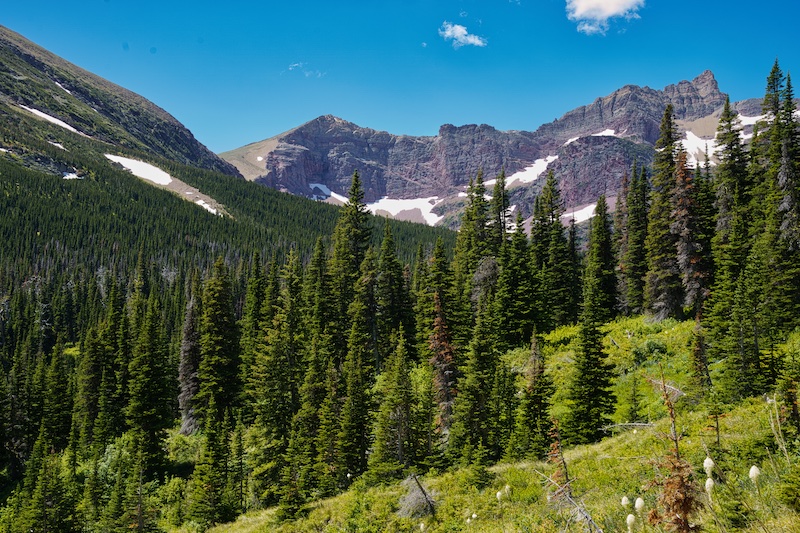
The footpath starts out passing between Rose Creek and the Rising Sun Cabins, then ascends 390 feet in just over half a mile. The trail then eases up as it continues to ascend along the southwest flank of Otokomi Mountain.
In July 2015, the Reynolds Fire ignited about six miles east of Logan Pass and burned to the northeast. By the time firefighters controlled the blaze in September, it had consumed 4,458 acres.1 The first part of this hike travels through part of the damage caused by that fire. You won’t find a blackened landscape, but you will find lush growth and witness the amazing ability of the land to heal.
I counted no less than 20 different species of wildflowers. Shrubs like serviceberry, elderberry, and huckleberries abounded. Young lodgepole pine and Douglas fir trees seemed healthy and well on their way to making a new forest. I was especially happy to see some whitebark pine seedlings and saplings. White pine blister rust, a fungus brought into our country from Europe, has decimated this keystone species.
As you approach the two-mile mark, listen for the first of several waterfalls. Some are distant, while others will be close enough to the footpath to photograph.

At four miles, the trail begins a long sweeping course change from northwest to southwest as it zeroes in on a mile wide glacial cirque named Rose Basin. This is the home of Otokomi Lake. When you reach the scree field, you are about 0.6 miles from the lake.
The trail passes the three-site Otokomi campground. Glacier officials have set two out of the three campsites aside for reservations. Continue on the path along Rose Creek for a short distance to reach the lake.
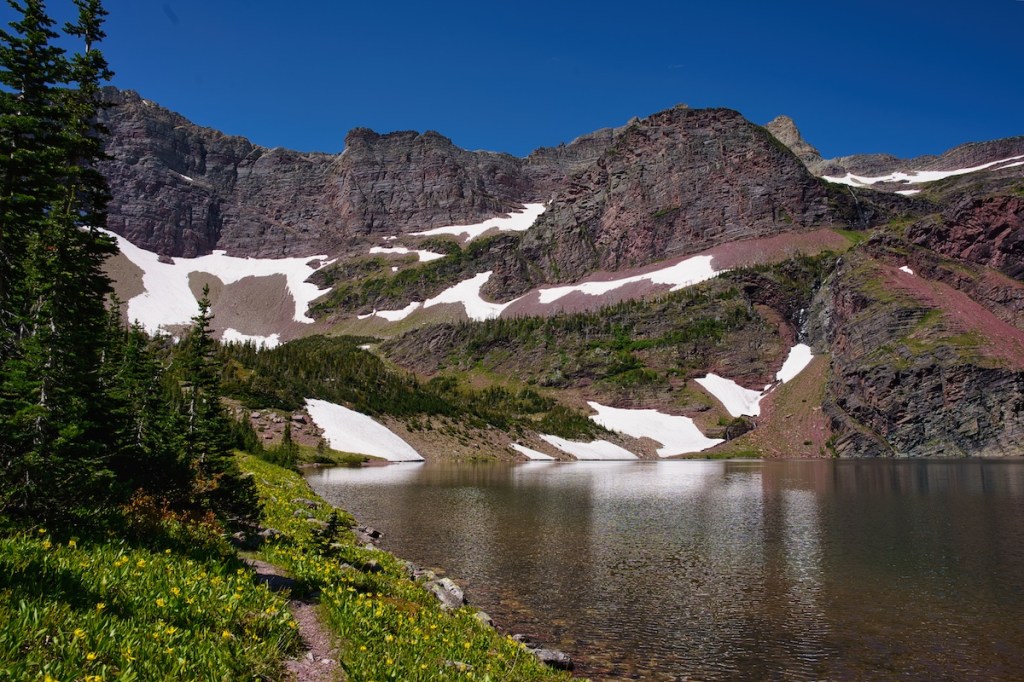
Otokomi Lake lies atop the Appekuny and Grinnell rock formations.2 The greenish-gray rock is from the Appekuny and the red from the Grinnell formation. These stones are over a billion years old, with Appekuny being the older. Rivers and streams carried the rock-forming sediment to the ancient Belt Sea before any complex life forms existed on the planet. Combined, these two formations are over 4,000 feet thick.3 Sedimentary rock formations in the park comprise some of the oldest and best preserved in the nation.

If you have any interest in exploring the far side of this 25-acre beauty, I suggest not using the logjam. Instead, walk back downstream a short distance and look for shallow riffles. You’ve found the crossing point if you see what looks like a small stream bed entering Rose Creek on the far side of the riffles. Dedicated water shoes and hiking poles for balance would be ideal for fording the stream. Head up and to the right on the south side to find the narrow, somewhat overgrown trail. It’s not far.
It’s easy to linger when the footpath enters tiny-lakeside meadows colored yellow with glacier lilies in early summer. Near the head of the lake there’s a small beach area with a grand view of the snowmelt-fed waterfall crashing over 500 feet down the red cliffs of the headwall.
A final friendly reminder. Bears make use of the Rose Creek drainage. So, be sure to leave yourself enough time to reach the trailhead before dark. Always carry bear spray where you can access it in a second or two. Know when and how to use it. And it’s wise to hike in small groups making enough noise to avoid surprising a bear, which can cause a wonderful day to go south in a hurry.
Notes
- “Fire History.” National Park Service, Glacier National Park. Last modified June 24, 2023. https://www.nps.gov/glac/learn/nature/fire-history.htm.
- MacLeod, David M. “Latest Pleistocene and Holocene Paleo-Environments, Rose Basin, Glacier National Park, MT.” PRISM, University of Calgary. Last modified May , 2003. https://prism.ucalgary.ca. doi:10.11575/PRISM/23269.
- Raup, Omer B., Robert L. Earhart, James W. Whipple, and Paul E. Carrara. Geology Along Going-to-the-Sun Road Glacier National Park, Montana. West Glacier, MT: Glacier Natural History Association, 1983.
- Schultz, James W. Blackfeet and Buffalo: memories of life among the Indians. Norman, OK: Oklahoma Press, 1962.
 EXPERIENCE GLACIER NATIONAL PARK